01 Introduction
Authors: vaticinator.net & astrostarcheck.com
2026-08-31 · 01-introduction.md
Chapter 1. Introduction: Why Did Distant Civilizations Adopt Isomorphic Mathematics for Fortune-Telling
1.1 The Problem
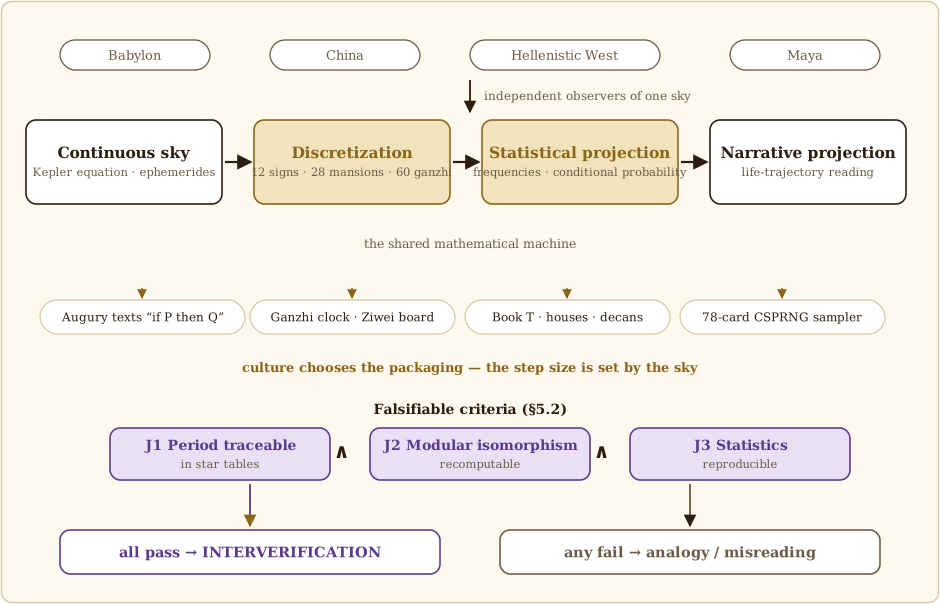
The Chinese Imperial Astronomical Bureau kept time by sexagenary cycle and judged regions by twelve houses; Babylonian priests recorded heaven–affairs correspondences on seventy tablets; Maya priests forecast eclipses with a 405-month table; post-Renaissance Europe cast fate with the twelve zodiacal houses and house systems. Four traditions, thousands of miles and millennia apart, use highly isomorphic mathematics — periodic divisibility, modular table-lookup, small-sample counting. This book starts here: was the isomorphism borrowed, or is it the necessary output of one mathematical substrate?
Existing research mostly chooses the first approach: tracing transmission chains (the eastward journey of the Babylonian–Greek–Indian zodiac into China; Jesuit calendrical inputs to the East). Transmission is factual, but its explanatory power stops at "who invented first." This book chooses the second, arguing: even setting aside every transmission hypothesis, civilizations observing one sky would independently arrive at similar discretizations — because the sky's mathematical structure (the ecliptic continuum, the Moon's 27.3-day circuit, planetary synodic periods) allows only a few good discretizations: twelvefold division, twenty-eight stations, and the sixty-cycle.
1.2 Core Thesis
Celestial motion is itself a mathematical model; fortune-telling is statistical analysis of its long observational record, projected as life-trajectory narrative. East (Wu Xing with the five planets, Bagua, Zi Wei Dou Shu) and West (tarot–astrology correspondences, the zodiacal houses with the house system) independently invented isomorphic discretization schemes. Such cross-civilizational convergence is not coincidence but the necessary output of one mathematical substrate, and the two systems corroborate each other when judged by these criteria.
1.3 Three Falsifiable Criteria, Chapter Plan
For claims of corroboration to differ from mystical association, they must be falsifiable. Three criteria are adopted: documented common periodicity (e.g., Jupiter's 11.86 years ≈ one twelve-year branch cycle, verifiable against ephemerides; if planetary periods prove unrelated to the Five-Phase assignments, the criterion fails); verifiable modular isomorphism (Z₅ permutations, modulo-12 house rotation, sexagenary generation rules, each can be recomputed independently, and any failure on recomputation fails the criterion); reproducible statistics (the Dresden table's reset-correction mechanism on record; this study's yoked experiment, preregistered — a null result fails the criterion).
The plan: Chapter 2 lays the celestial-model foundation; Chapter 3 gives the three Eastern models; Chapter 4 the three Western models; Chapter 5 closes the corroboration with yoked experimental evidence; appendices hold every recomputable table. In the main text, mathematical claims appear as conclusions; derivations are in the appendix.