02 Celestial Mechanics as Mathematical Model
Authors: vaticinator.net & astrostarcheck.com
2026-08-31 · 02-celestial-model.md
Chapter 2. Celestial Mechanics as Mathematical Model
The chapter's foundational proposition: pre-telescopic astronomy was already a mathematical machine, and fortune-telling merely discretizes and narrates its output. §2.1 establishes the deterministic core, §2.2 enumerates the discretization schemes civilizations actually adopted, and §2.3 defines "statistical projection." Literature survey and derivation details are collected here; every section can be verified independently.
2.1 The Deterministic Core: From Kepler to Ephemerides
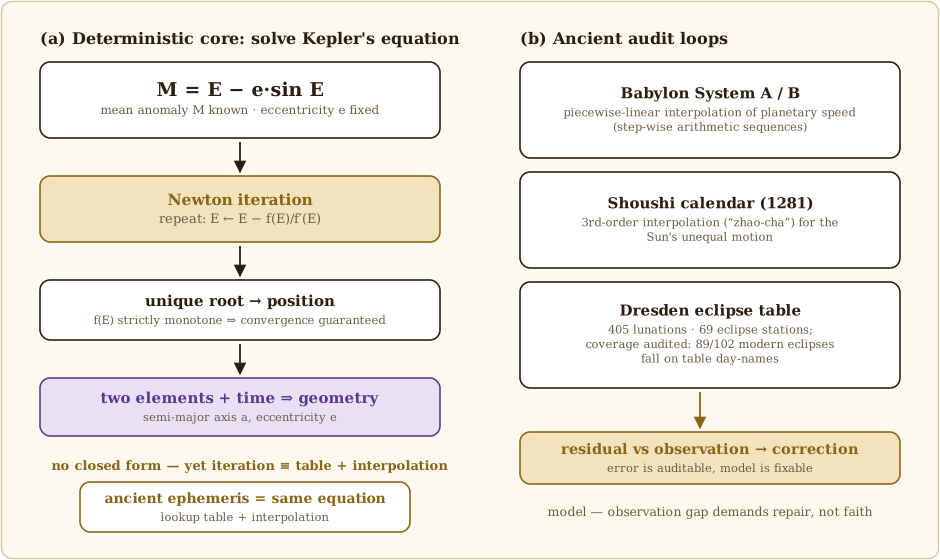
2.1.1 How Kepler got the three laws. Tycho's Martian observations disagreed with circular-orbit predictions by ~8 arcminutes (about one 2,700th of a circle), far beyond observational error; Ptolemaic epicycles showed systematic residuals at this level — non-random, periodic, indexing structural model error. Kepler tried ovoids (infinitely many, indistinguishable by data), then abandoned them for areal-velocity constancy (second law) constraining swept area, then an ellipse (first law) — residuals fell into observational noise (first two laws, 1609; the third — squared periods proportional to cubed semi-major axes — 1619). The point for this book is computational: Mars' position fixed uniquely by two parameters (semi-major axis, eccentricity) plus time, no per-point tables. Newton's Principia, Book I, Props XI–XIII, proved both directions: inverse-square gravitation entails conic-section orbits, and conic-section orbits entail inverse-square gravitation. This turned "orbit = ellipse" from a fitted curve into a consequence of dynamics. This book needs only the computational consequence of that chain (Kepler 1609; Stephenson 1987), not its physical commitment: orbital elements plus time uniquely fix geometric configuration.
2.1.2 How ephemerides compute. Modern ephemerides (e.g., VSOP87, Bretagnon & Francou 1988) take Julian Day Number as argument, solve Kepler's equation M = E − e·sinE (M mean anomaly known, E eccentric anomaly iterated by Newton's method), then correct by perturbation series to apparent place. Kepler's equation has no closed-form solution, only iteration — but iteration converges to a unique root (f(E) = E − e·sinE − M strictly monotone), so solving the equation is, computationally, the same as table lookup plus interpolation. Ancient ephemerides are tabulated implementations of the same equation: Babylonian Systems A/B (Neugebauer 1955, 1975) interpolate planetary velocity by piecewise-linear arithmetic progressions — System A bins by zodiacal longitude, System B bins by time; both piecewise-linear, with errors that can be audited (comparison with observation reveals which bin fails); China's Shoushi calendar treats solar anomaly by cubic interpolation (zhaochashu; Sivin 2009, quoted text 2.1.2a below). Same computational character: given epoch, the configuration at any moment is recoverable, with errors that can be audited and corrected.
Quoted text 2.1.2a (Yuanshi, "Treatise on Calendars," on the Shoushi calendar's method of finite differences; translated from the Chinese). "There are the methods of die (stacking), zhaocha (finite differences), gougu (right-triangle), and hushi (arc-sagitta), which earlier practitioners of step-reckoning had not made clear. First by observation, then by close computation, one obtains the essentials of step-reckoning and works out the system in detail. … The licheng (ready-reckoner) sets out in advance the numbers of the excess and deficit, the slowness and speed, of Sun, Moon, and the five planets, so that step-reckoning may draw on them. After the Qianxiang calendar, only equal differences were used; the Daye calendar first added fixed differences; by the time of Shoushi, standing differences were added again. … The three differences, ping, ding, and li, are used as what today is called the method of successive comparison. Reaching the third difference yields the most detailed reckoning of the motions of the seven luminaries." (Yuanshi, juan 52.)
Codicological note 2.1.2b. (i) "First by observation, then by close computation" is Guo Shoujing's own description of his method: measure first, compute closely after. That is a procedural statement of "make the model match the data," of one kind with the Dresden eclipse table's "corrigible" practice. (ii) "Equal, fixed, and standing differences" are first-, second-, and third-order differences — the textual basis for cubic interpolation — and "reaching the third difference yields the most detailed reckoning" states outright that the third-order difference is the most precise. (iii) This passage supports the assertion in §2.1.2 that the Shoushi calendar handled solar anomaly by cubic interpolation (zhaochashu), turning that assertion from paraphrase into a citation with a primary-text basis.
2.1.3 The Dresden eclipse table: an ancient corrigible model. Dresden Codex pp. 51–58 carry the eclipse table, whose structure follows Justeson & Lowry (2025, Science Advances 11(43): eadt9039, doi:10.1126/sciadv.adt9039): across 405 consecutive lunations (11,960 days, 32.7 years) the table lists 69 stations, of which 55 are expected eclipse-warning stations and 14 are structural stations, spaced five, six, eleven, or seventeen months apart. The table began as a general lunar calendar; after several repetitions, observed eclipse intervals suggested the station series. The table does not simply loop: successor tables reset at month 358 or 223 of the current one (corresponding to the Inex and Saros cycles of modern astronomy), and a four-to-one combination yields a 1,655-month (≈134-year) master cycle with mean errors under 51 minutes; checked against the modern canon (Espenak & Meeus 2006), the scheme covers every solar eclipse visible in the Maya region between 350 and 1150 CE. That is an ancient case of "computable and corrigible": coverage is an audit metric, not a statement of faith.
Corollary: ancient fortune-telling never faced a chaotic sky, but a mathematical machine with stable output. Dispute can only concern "how the output is read," never "whether the output exhibits regularity" — a question long settled in every calendrical tradition.
2.2 Discretization Schemes: Twelve, Twenty-Eight, Sixty
The continuous ecliptic must be discretized to enter divination. Three major schemes survive, and their mathematical motives are transparent:
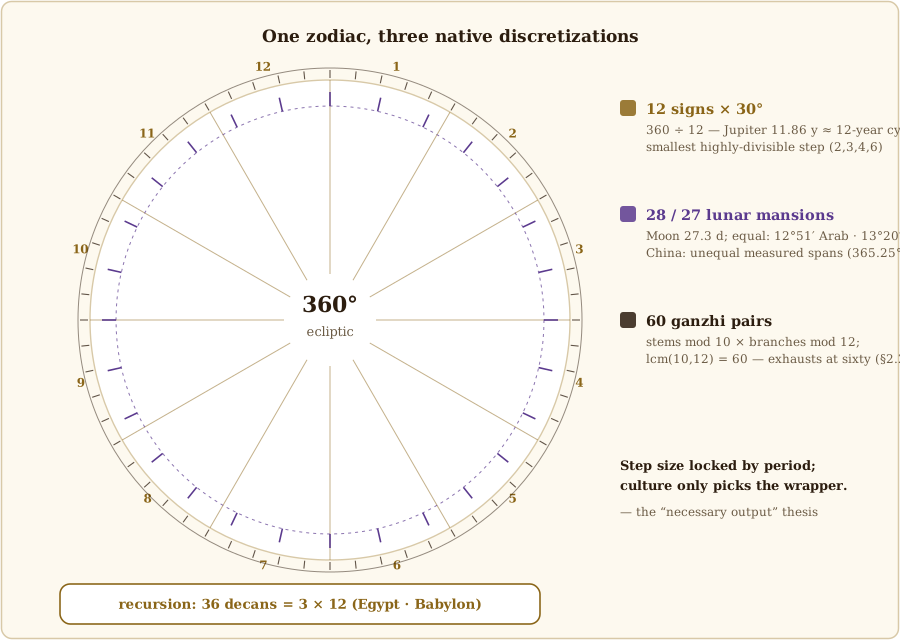
Twelvefold division. Babylonian sexagesimal gives the 360° circuit (360 = 6×60, richly divisible); the Greek-transmitted Western twelve, China's twelve ci-divisions and twelve-branch houses are different cultural packagings of "360÷12 = 30." Two celestial facts lock it in: Jupiter's 11.86 years ≈ one twelve-year circuit (one branch per year — the Jupiter-year chronology is exactly this); Saturn's 29.46 years ≈ a thirty-year round — thirty years being the traditional length of one Chinese "generation" (Shuowen: "thirty years make one generation"; Lunyu: "if a true king arose, it would still take a generation for benevolence to prevail"), generational turnover resonating with the Saturnian period; this is a working hypothesis, not a factual claim. Twelve qualifies as a good discretization for number-theoretic reasons — few small integers divide so evenly (2, 3, 4, 6) — and the Jovian period selects it as well. Babylon added thirty-six decans (three per house) as a refinement layer, showing that division can be applied recursively — a recursiveness used again below for house-division geometry (§4.1).
Folk legend 2.2a (the origin of the twelve zodiac animals). The most widely told folk legend attached to the twelve-year branch cycle is the twelve zodiac animals. One account has the Yellow Emperor choosing twelve animals to preside over the years; another has the Buddha summoning animals as guardians before his nirvana; a third has the Jade Emperor settling the twelve ranks by a race. Divergent as these narratives are in detail, they all presuppose "one cycle in twelve years," which is isomorphic with the year-star's (Jupiter's) twelve-year circuit (§3.1.2). The one-to-one pairing of animals with branches (Zi-rat, Chou-ox, …) was already fixed by the late Warring States, as the Yunmeng Shuihudi Qin bamboo Rishu records animals paired with branches. What the legends do not supply is any astronomical rationale for which animals occupy which slots — the rat winning first place while the dragon fails to place is pure literary invention, and the zodiac stories carry no astronomical content whatever. The productive distinction, then, is between the cycle and the packaging: the twelve-year period is locked by astronomy, while the choice of animals is culturally arbitrary. This is the folk version of §2.3's principle that "discretization step sizes are locked by celestial periods, and civilizations choose the packaging" — the zodiac animals are the packaging, 12 is the step.
Twenty-eight mansions. The Moon's 27.3-day circuit, rounded, gives twenty-eight stations. The three traditions differ in mathematical character and need separate statements: Arabic manazil are equal-division, 360÷28 ≈ 12°51′ per station; Indian nakshatras are twenty-seven equal divisions of 13°20′ (27×13°20′ = 360° exactly, with variants inserting a twenty-eighth, Abhijit); China's twenty-eight xiu are unequal, widths ranging from ~1 du (Zi) past 30 du (Jing), summing to 365.25 celestial du — measured stellar separations in equatorial coordinates, not arithmetic partition. The contrast serves this book's thesis: equal-division schools (Arab, Indian) take "step-size locking," the measured school (Chinese) takes "star-position locking" — both faithful projections of lunar dynamics, differing only in projection mode (on the measured character of the Chinese system, Sun & Kistemaker 1997; on the India–Babylonia debate, Pingree 1973). Appendix A-2 tabulates the three traditions.
Proof 2.4 (Equal-division steps as arithmetic necessity). 360 ÷ 28 = 12.857142…° = 12°51′26″, the manazil station width; 360 ÷ 27 = 13.333…° = 13°20′ exactly, with 27 × 13°20′ = 360° — the arithmetic reason nakshatras take twenty-seven, not twenty-eight. Equal-division step sizes are locked by division, not cultural choice. QED.
The sixty-cycle. Ten stems and twelve branches are both modular sequences; least common multiple lcm(10,12) = 60, so pairing from Jiazi necessarily restarts after sixty (an instance of the Chinese remainder theorem: the pairings are the first sixty joint solutions modulo 10 and 12). Metonic rule: nineteen tropical years (6,939.6 days) ≈ 235 lunations (6,939.7 days), within a day — hence seven intercalations in nineteen years. Saros: 223 lunations (6,585.32 days) ≈ nineteen eclipse years, Sun–Moon–node geometry resetting — hence eclipses predictable. Fortune-telling time rulers are essentially dials of such rational approximations.
Proof 2.1 (Sixty pairings, distinct and exhaustive). Let f(i) = (i mod 10, i mod 12). gcd(10,12) = 2, lcm = 60. If f(i) = f(j) with i < j, then 10 | (j−i) and 12 | (j−i), hence 60 | (j−i). So i = 0,…,59 are pairwise distinct — sixty pairs; f(60) = (0,0) = Jiazi, restart. QED. Appendix A-6's i = 10 (Jiaxu) is its direct corollary.
Proof 2.2 (Metonic). Tropical year 365.2422 days, lunation 29.530589 days: 19 × 365.2422 = 6,939.60 days; 235 × 29.530589 = 6,939.69 days; difference 0.09 days < 1 day. Hence seven intercalations in nineteen years keep calendar months in season. QED.
Proof 2.3 (Saros). 223 × 29.530589 = 6,585.32 days; eclipse year 346.6201 days, 19 × 346.6201 = 6,585.78 days; difference 0.46 days. After 223 lunations the Sun–Moon–node geometry nearly resets — hence eclipses predictable. QED.
Common point: discretization step sizes are locked by celestial periods; what civilizations could choose was only packaging (houses, mansions, stems-branches). That is what the "necessary output" thesis means, in mathematical terms.
2.3 Fortune-Telling as Statistical Projection: Definition
Definition (this monograph): fortune-telling = statistical analysis of the long observational record of a celestial mathematical model, projected as life-trajectory narrative. Here "statistics" means three things: frequency induction (what human affairs accompany a given ingress), conditional probability (the Babylonian "if P then Q" form), and individual positioning (mapping birth moments to model coordinates, as in Zi Wei palace-fixing or house division). "Projection" means dimension-reducing narration from multi-dimensional celestial states to one-dimensional life counsel. One more step is needed: why statistical analysis necessarily yields narrative. Statistics give only conditional probabilities or frequency tables (e.g., "planet x entering house y often accompanies affair z"), multidimensional and nonlinear, which cannot directly give one-dimensional advice; compressing multi-dimensional results into one-dimensional counsel necessarily passes through narrative interpolation (selection, ordering, causalization). So interpolation is unavoidable, and honesty depends on admitting it — auditable systems admit it (Dresden kept correction records), unauditable ones deny it (the stretchable interpretation of tarot readings, see Chapter V).
This definition turns all later arguments into decidable propositions: correspondences satisfying "documented common periodicity, verifiable modular isomorphism, reproducible statistics" count as corroboration; the rest fall under formal analogy or misreading.