03 Eastern Models
Authors: vaticinator.net & astrostarcheck.com
2026-08-31 · 03-eastern-models.md
Chapter 3. Eastern Models: Wu Xing with the Planets, Bagua, Zi Wei
This chapter gives formal descriptions of three Eastern "astronomy-to-divination" devices, plus a comparison subsection with the Western house system. The rule for this chapter: record only verifiable structural facts (periods, modular rules, correspondence tables); interpretive claims go to Chapter 5.
3.1 Wu Xing with the Five Planets: The Planets Are the Phases' Names
3.1.1 Text: the Mawangdui Wuxingzhan. Wood, Fire, Earth, Metal, Water are first of all names of five planets: Jupiter, Mars, Saturn, Venus, Mercury. The Mawangdui Wuxingzhan (ca. 170 BCE, ~8,000 characters in nine chapters — one per planet plus a general discussion) draws omens from planetary stations; Cullen (SCIAMVS 12, 193–249) establishes its mathematical structure: each planet's entries open with a five-fold cosmological formula before station-omen records — planetary data and the Five-Phase frame interlocked at the textual layer, not by later association.
Quoted text 3.1.1a (Wuxingzhan, ch. 1, Jupiter; translated from the Chinese). "East is Wood; its emperor is Taihao, its assistant Goumang, its spirit ascends as the year-star. The year-star dwells in a state, and presides over the year. The year-star rises heliacally with Yingshi in the first month, named Shetige. … In the next year with Xun in the twelfth month it rises heliacally, named Chifennuo. In the following year with Yingshi in the first month it rises heliacally again — Shetige, completing the circuit in twelve years. … In all, 395⅛ days until it rises heliacally again. … It travels 20 fen per day, one du per twelve days. … The twelve year-names are the heavenly stems." (Mawangdui silk manuscript; Wikisource transcription.)
Codicological note 3.1.1b. Three facts here lock astronomy to the ganzhi frame: (i) "Shetige again, completing the circuit in twelve years" — the twelve-year Jovian circuit maps one-to-one onto the twelve branch-years and the twelve year-names (Shetige through Chifennuo), a calendrical structure, not rhetoric; (ii) "In all, 395⅛ days until it rises heliacally again" — the synodic period ≈ 395 days against a modern 399 (within 1%; rounded on the silk), pacing omen windows; (iii) "the twelve year-names are the heavenly stems" — year-names tied to stems, directly supporting the "period lock" thesis. Cullen's structural study complements: his evidence is form, this evidence is data.
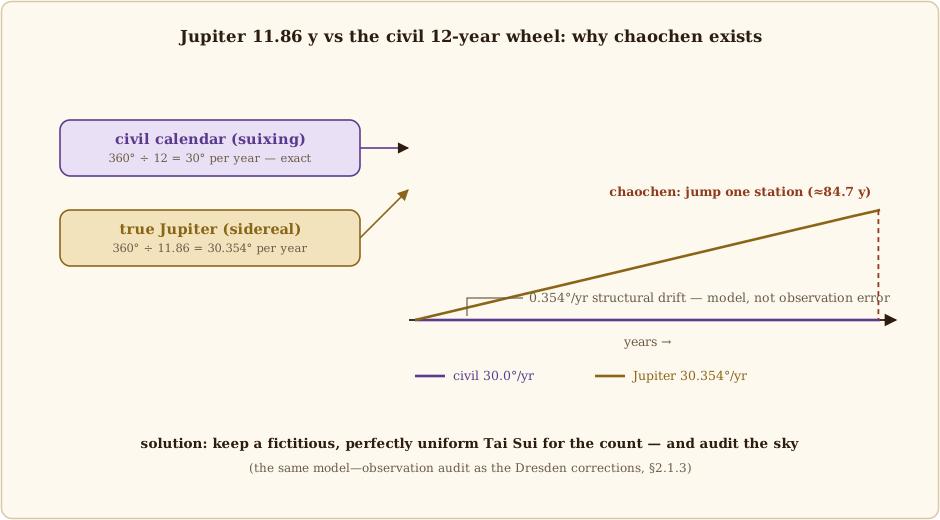
3.1.2 Period lock: the Jupiter chronology and the chaochen correction. Jupiter's sidereal 11.86 years ≈ one twelve-year circuit, one branch per year — the Jupiter-year chronology. But 11.86 ≠ 12: Jupiter travels 360/11.86 = 30.354° per year against the 30° per branch — a 0.354°/year excess accumulating one full branch (30°) in 30/0.354 ≈ 84.7 years, i.e. one chaochen per eighty-odd years. The deviation stems from incommensurability of the sidereal and calendrical periods (12 and 11.86 share no common divisor), not observational error — a structural model bias, of one kind with the systematic residuals of §2.1.1. The ancient fix was chaochen (the system is documented in Sivin 1969: one branch decreed skipped to re-sync), plus an imaginary uniform Taisui replacing observed Jupiter for omen purposes (the Shiji "Tianguanshu" carries both systems side by side).
Quoted text 3.1.2a (Shiji, "Tianguanshu," Jupiter entry; translated from the Chinese). "He observes the motions of Sun and Moon to gauge Jupiter's direct and retrograde. … Jupiter's ying-suo [excess-deficit] makes its station name the state. The state it occupies cannot be attacked; one may only punish there. Advancing on its station is called ying; retreating from station, suo. Ying, the state has unending war; suo, the state has grief, its ruler will perish, the state collapses." Again: "It travels 30⅟₁₆ du per year, at the rate of 12 fen per day, completing the circuit in a year." (Zhonghua punctuated edition.)
Codicological note 3.1.2b. (i) "30⅟₁₆ du per year" — twelve years accumulate 365.25 du, i.e. a model period of exactly 12.00 years against the observed 11.86. The model–observation gap (about a seventh of a year) is precisely the deviation chaochen was to correct — primary textual evidence for the model–observation audit view. (ii) The ying-suo omens hinge on station; stations follow observed position, so observed drift enters judgments directly and must be corrected by the chaochen procedure (cf. Argument 3.3). The detail matters: it shows the Chinese tradition holding the audit view that the gap between model and observation must be corrected — the same disposition as the Dresden eclipse table's correction records, and an instance of checkable scientific practice (§2.1.3).
Folk legend 3.2a (the zodiac year and offending Tai Sui). The year-star (Jupiter) circuits the sky in twelve years and the branches run in twelve-year rounds — and from this comes China's most widely spread folk belief: that one's zodiac year offends Tai Sui, that whoever holds Tai Sui's station suffers calamity that year, and must wear red to ward off evil and propitiate Tai Sui. The zodiac year (holding Tai Sui's station) and the opposing Tai Sui (the year of opposition) do carry real astronomical correspondences: one who holds Tai Sui was born under the same branch as the current year (a Zi-year person meeting a Zi year), while opposing Tai Sui means meeting the directly opposed branch (Zi and Wu oppose). This correspondence is the direct product of projecting the year-star period modulo 12, isomorphic with the year-star–branch lock of §3.1.2 — mathematically real and checkable. The folk elaboration, however, goes considerably further. The "Tai Sui star-lord" becomes a personified deity (each of the sixty jiazi assigned a star-lord general, Jiazi being General Jin Bian), and the whole apparatus of branch relations — opposition, punishment, destruction, harm — is folded into "offending Tai Sui," which already exceeds the mathematical content of Jupiter mod 12 and belongs to a mythological layer of cultural accretion rather than astronomical projection. This book's criteria (§5.2) credit only the mathematical layer; the mythological overlay is exactly the "mistaking correlation for causation" that §5.3 criticizes. Wearing red to ward off evil is a causal claim with no mechanism behind it — a case of mere association. Fairness requires noting, however, that even this associative overlay must parasitize an astronomical structure to gain credibility, which from the reverse side confirms the book's thesis: the folk belief derives whatever traction it has from the genuine mod-12 substrate underneath.
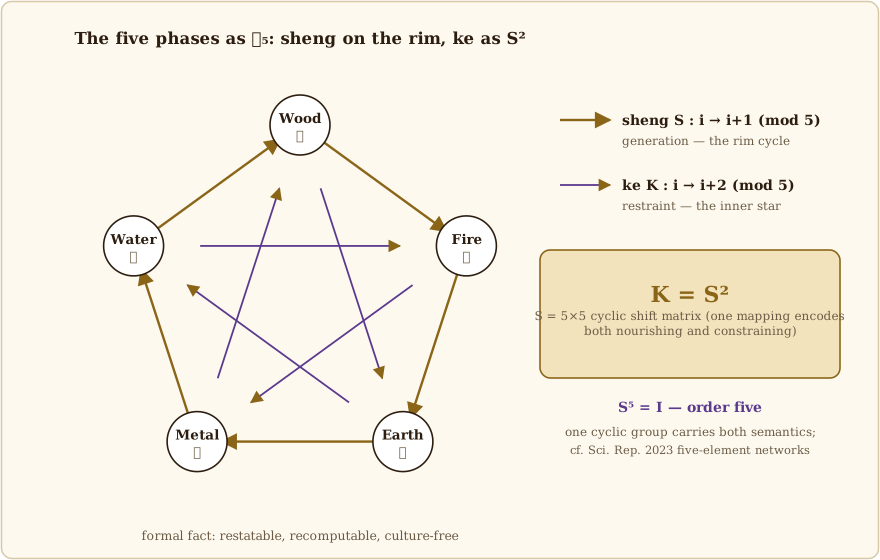
Argument 3.3 (chaochen is audit). P1: when observed Jupiter lagged the chronological branch, a skip-one-branch decree re-synced them (sources: Shiji "Tianguanshu," Han calendrical treatises). P2: an imaginary uniform Taisui replaced observed Jupiter for omen use — model values substituted for observed values. P3: this system admits model–observation deviation and corrects it by written procedure. Conclusion: the Chinese calendrical tradition contains an audit link, of one character with Dresden's correction records. The deduction is valid; the cited sources secure the premises. 3.1.3 The Z₅ theorem, proved. Label Wood 0, Fire 1, Earth 2, Metal 3, Water 4. Generation S: i→i+1 (mod 5); overcoming K: i→i+2 (mod 5).
Proof 3.1. S is the 5×5 cyclic shift matrix: S[i][(i+1) mod 5] = 1, zeros elsewhere. Let S2 = S·S; S2[i][j] = 1 iff some k has S[i][k] = S[k][j] = 1, iff k = i+1 and j = i+2. Hence S2[i][j] = 1 iff j = i+2 (mod 5) — exactly the definition of K. S⁵ = I, five shifts resetting. QED.
One cyclic group of order five encodes both "nourishing" and "checking" semantics — this formal economy explains why the system lasted two millennia without replacement. Existing quantitative studies of Wu Xing mostly stop at restating the generating–overcoming structure in modern mathematical dress (graph-theoretic networks, stochastic operators); this monograph adds the controlled protocol of §5.4.
3.2 Bagua Three-Bit Binary, with the Twenty-Eight Mansions
3.2.1 Square/circle diagrams and binary order. Bagua is three-bit binary (yang = 1, top-down): Qian 111 down to Kun 000, the Fuxi order exactly descending 7 to 0 (verified). Shao Yong's Former-Heaven square (sixty-four hexagrams in eight rows and columns) reads across as binary ascending (each row shares one upper trigram over eight lower trigrams in 000-to-111 order; each column shares one lower trigram over eight upper trigrams in 111-to-000 order; the whole square reads as a complete binary count of sixty-four), the circle reads around as descending — exactly the arrangement Leibniz saw in 1703 (Leibniz 1703; Ryan 1996). The coexistence of ascending and descending order shows the binding of order to counting direction: one structure, read two ways. The reading-direction dispute (the sinological bottom-up line reading against the Bouvet–Leibniz top-down; the literature is surveyed in Ryan 1996) is flagged and left undecided. It concerns the meaning of individual lines, not the formal fact below.
Proof 3.2 (hexagram–bitstring bijection). Each line bivalent; three lines give 2³ = 8, exhausting Bagua; upper and lower trigrams of three lines each, six lines give 2⁶ = 64, exhausting hexagrams. The map (yang→1, yin→0, top-down) is injective (distinct hexagrams differ in some line) and surjective (any six-bit string draws a hexagram bitwise). So the Fuxi descending order from 7 to 0 is an ordering claim anyone can check. QED.
Folk legend 3.2b (Fuxi drawing the trigrams and King Wen elaborating the Zhouyi). Two great legends surround the origin of the eight trigrams and the sixty-four hexagrams. One says that Fuxi looked up to observe the patterns of heaven and down to examine the order of earth, and so drew the eight trigrams (Yi, "Xici": "looking up, he observed the patterns in heaven; looking down, he examined the order on earth"); another says that King Wen, imprisoned at Youli, elaborated the Zhouyi, doubling the eight trigrams into sixty-four hexagrams (Shiji, "Annals of Zhou": "Lord Xi of the West, in some fifty years from his accession, was imprisoned at Youli, and there increased the eight trigrams of the Yi into sixty-four"). Both legends tie the origin of the hexagram system to the observation of heaven and earth — "looking up and down to observe" is observation, and observation is the source of discretization — pointing in the same direction as §3.2.1's thesis of astronomical correspondence. Yet the evidentiary problems are significant. The legendary "Fuxi drew the trigrams" has no contemporaneous textual evidence: Fuxi is himself a mythological figure. "King Wen elaborated the Yi" is likewise a Han-classicist retrojection; the Mawangdui silk Yi preserves a hexagram order differing from the received text, which shows that the order always had variants and cannot be traced to a single authorial moment. Attributing the system to one sage is hero-narrative simplification, not historical record. What this dispute does not affect is the formal fact that the sixty-four hexagrams = 2⁶ — just as §3.2.1 already noted that the reading-direction dispute (bottom-up or top-down) leaves the formal count equally untouched. Legend supplies attribution (who, when, why); form supplies structure (how many bits, how many kinds, in what order). The two can coexist, and the attribution dispute cannot overthrow the structural fact. The "sixty-four–seventy-eight" comparison of §5.1 rests on exactly this distinction.
3.2.2 Why the mansions share the section. Twenty-eight mansions round the Moon's 27.3-day circuit (~12°51′ per station); China's unequal measured system (summing to 365.25 celestial du, §2.2) belongs with Bagua to the same "positional counting plus modular computation" substrate. Appendix A-2 tabulates the three traditions. Together they show that at the bottom of Chinese computational arts lie counting and modular arithmetic, not mystical intuition.
3.3 Zi Wei Dou Shu: Modular Natal Charts and Their House Comparison
Quoted text 3.3.1a (Zi Wei Dou Shu Quanshu, vol. 2, "Formulas"; translated from the Chinese). "Xiyi looks up at the stars of heaven, and makes Dou Shu to reckon human fate. He does not follow the five planets past the solar terms, but treats only year, month, day, hour of birth. First fix body and life, next set the Ju; then Zi Wei and Tianfu spread the stars. Jie-kong, shang, shi, Tiankui, Yue, Tianma, Tianlu with the baleful spirits; the front sheep, rear Tuo, with the four transformations; Hongluan, Tianxi, Fire, Bell, Punishment." (vol. 2, Wikisource.)
Quoted text 3.3.1b (same work, life/body example and the Five-Tigers example; translated from the Chinese). "Human fate generally starts from Yin in month one, counting forward to the birth month; then from the birth month, counting backward by the hour from Zi to the birth hour fixes the life palace, forward to the birth hour fixes the body palace. … The Nayin jiazi song must be read closely. For a Jia-born person whose life is in Yin, the Five-Tigers starts Jia/Ji years with Bingyin; that is Bingyin Dingmao, furnace-fire; go to the fire Ju and seek by birth day the Zi Wei sovereign. If born on month one, day one, it is the fire Ju; count from You on day one, and Zi Wei rises from You." Also: "Five-Tigers year-start example: Jia/Ji years start Bingyin, Yi/Geng start Wuyin, Bing/Xin start Gengyin, Ding/Ren start Renyin, Wu/Gui start Jiayin." (vol. 2)
Codicological note 3.3.1c. (i) "First fix body and life, next set the Ju, then Zi Wei and Tianfu spread the stars" — the formulas self-acknowledge the order (body/life, Ju, stars), matching this book's six steps; not a later reconstruction. (ii) "born on month one, day one, it is the fire Ju; count from You on day one, and Zi Wei rises from You" — Zi Wei positioning as (day ÷ Ju) remainder is stated in the primary text; the modular core has textual basis. (iii) "Jia/Ji years start Bingyin" — the Five-Tigers verse appears in vol. 2 under the heading "Five-Tigers year-start example," a textual rule, not an oral legend. (iv) "The Nayin jiazi song must be read closely" — the original itself demands mastery of the Nayin song to set the Ju; Nayin Ju-setting is primary-text procedure, not modern gloss.
3.3.1d Transformation table supplement. The four transformations (lu, quan, ke, ji) read by birth-year stem row and star column, forty entries across ten stems.
3.3.1 Chart-fixing algorithm, all steps. Input: birth year-ganzhi, month, day, double-hour. Step 1, Five-Tigers traversal fixes each house's stem (mnemonic: Jia/Ji years start Bingyin for month one, and so on, modulo-ten rotation). Step 2, Nayin fixes the Ju bureau (Water-2, Wood-3, Metal-4, Earth-5, Fire-6). Step 3, Zi Wei positioning: birth date divided by the Ju number, the remainder fixing the Zi Wei house (the modular core). Step 4, Tianfu mapping: Tianfu's position fixed from Zi Wei's by a set involution (table lookup, no degrees of freedom). Step 5, four transformations by birth-year stem (e.g., Jia: Lianzhen→Lu, Pojun→Quan, Wuqu→Ke, Taiyang→Ji), forty across ten stems. Step 6, transits: major decades ten years per house in sequence, annual years by branch rotation. Each of the six steps can be recomputed independently from the formulas quoted above.
3.3.2 Information scale. Coarse estimate (flagged "coarse"; the old 600-count's error is corrected in Proof 3.4 — year-stem and Ju both derive from the year and may not be multiplied; the correct lower bound is 720). The input is nothing more than a birthday precise to the hour — low-entropy input, high-structure output, the mirror image of tarot's "high-entropy sampling, low-prior structure."
Proof 3.4 (coarse-family lower bound 720, correcting the old count). The year (60 jiazi) fixes the year-stem (→ house-stem sequence, transformation row) and the Nayin (→ Ju); year-stem and Ju are both functions of the year, not independent. The old count 10 × 5 × 12 = 600 double-counts — discarded. Correct factorization: year (60, fixing stem/transformations/stems/Ju) × life house (12, fixed by month and double-hour, independent of year) = 720. Birth date subdivides Zi Wei positions further, so true families only exceed this; 720 is a lower bound. QED.
3.3.3 Comparison with the Western house system. The Western twelve likewise divide the ecliptic into twelve, with life domains assigned. Directly comparable subset: Life–1st (self), Wealth–2nd (wealth), Siblings–3rd, Children–5th, Spouse–7th, Career–10th, Property–4th (household). Seven correspondences, different in wording, identical in skeleton as "mod-twelve labeling plus domain mapping." This needs no transmission hypothesis. If both sides observe the same ecliptic, it directly illustrates the "necessary output" thesis, decided under §5.2.