04 Western Models
Authors: vaticinator.net & astrostarcheck.com
2026-08-31 · 04-western-models.md
Chapter 4. Western Models: Houses, Book T, Mansions, and the Discrete Sampler
This chapter gives formal descriptions of three Western "astronomy-to-divination" devices, symmetric with Chapter 3: house geometry first, card correspondences next, the mansions triple tradition, closing with tarot combinatorics repositioned — tarot not as an appendage of astrology but as an independent discrete sampler.
4.1 The Twelve Houses and House Division: The Geometry of Partition
4.1.1 Two twelves. Zodiacal signs duodecimate the 360° ecliptic at 30° each; houses project from the observer's horizon–meridian. Post-Ptolemaic division methods differ in mathematical character: whole-sign (simplest modulo-twelve), Placidus (trisecting diurnal and nocturnal arcs — a time-trisection method), Regiomontanus (equatorial division projected; history surveyed in North 1986). Only one feature is shared: modulo-twelve labeling plus domain mapping. The reason is simple: division methods differ, yet their output is always twelve houses — because the twelve-domain system (self, wealth, siblings …) was already bound to the divided zodiac (§4.1.2); division methods only fix the positions of the twelve cusps, not the number twelve. So this book uses only what is shared; disputes over division methods do not affect the criteria below.
4.1.2 Twelve domain labels. The Western houses are self, wealth, siblings, household, children, illness, spouse, death, travel, career, friends, occult (the standard system since Ptolemy's Tetrabiblos; version differences leave the skeleton intact). The comparable subset with Zi Wei's twelve is in §3.3.3 (seven pairs). The point: the mathematics of house division is spherical geometry plus modular computation, isomorphic with the ganzhi "month-branch plus hour" rotation — an isomorphism anyone can check, with no transmission hypothesis needed.
4.1.3 Egyptian thirty-six decans: a refinement layer of twelve. The Egyptian decans (Old Egyptian bꜣkt.w, "workers") are thirty-six star groups dividing the ecliptic into thirty-six parts of ten degrees each, used at once for timekeeping: thirty-six forty-minute hours by night, and thirty-six ten-day weeks in the year (with five extra days). The system appears on coffin star-maps as early as the Egyptian Old Kingdom (Third Dynasty); in the Hellenistic period it was set beside the twelve signs on the Dendera zodiac disc (the ceiling relief of the Hathor temple at Dendera, ca. 50 BCE; on the star-map, Cauville 1997) — the outermost ring of the disc being precisely the thirty-six decans.
Translation 4.1.3a (English Wikipedia, "Dendera zodiac"; translated here). "Four goddesses and four falcon-headed figures, spaced forty-five degrees apart, support the celestial disc; the outermost ring of the disc bears thirty-six figures, representing thirty-six star groups, used both to mark the thirty-six forty-minute hours of the Egyptian night and to mark the thirty-six ten-day weeks of the Egyptian year (with five extra days)." (translated from English Wikipedia, "Dendera zodiac.")
Codicological note 4.1.3b. (i) The Egyptian thirty-six decans bear the same name and the same system as the Babylonian decans mentioned in §4.1 — two great civilizations each refining the twelve signs into three decans, a second independent instance of "equal division can be applied recursively," reinforcing §2.2's claim that twelve is a good discretization. (ii) The decans serve both calendrical timekeeping (a year of thirty-six weeks) and star-clock timekeeping (a night of thirty-six hours), showing the discretization scheme to be a mathematics shared by astronomy and the calendar, not astrology's private property — directly supporting the definition in §2.3 that "discretization step sizes are locked by celestial periods." (iii) On the Dendera disc the outermost decan ring stands beside the inner twelve signs, pictorial evidence for the recursion "thirty-six = three × twelve."
4.2 Book T: Codification of the Major Arcana Correspondences
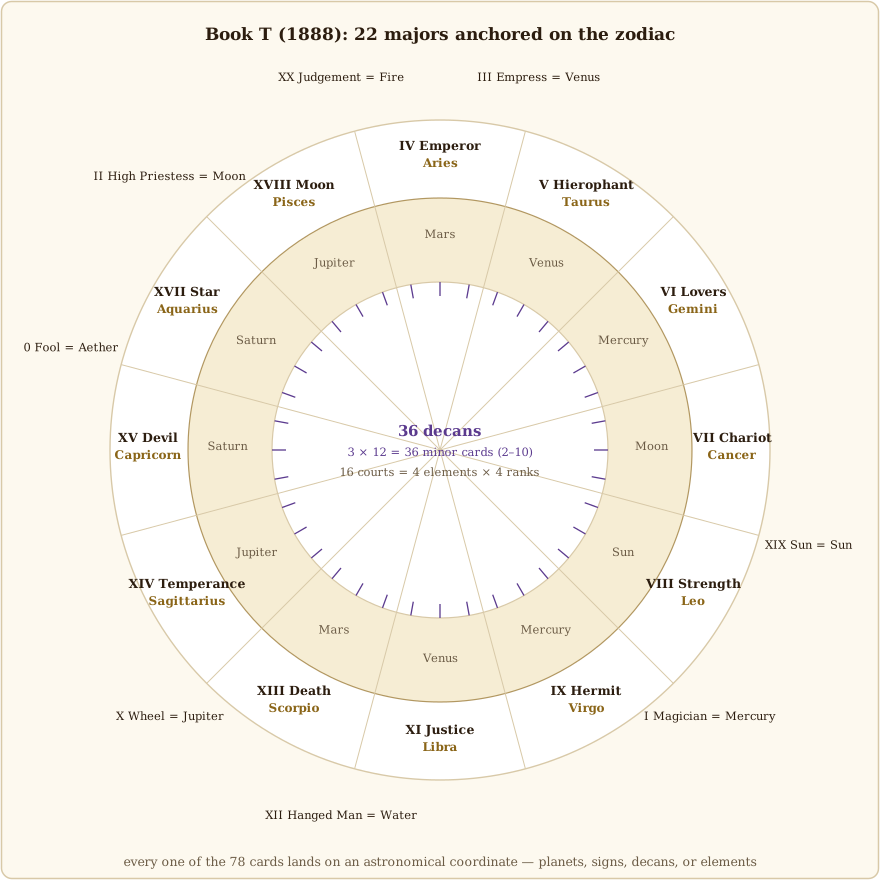
4.2.1 Genealogy. The French occultist Alliette (Etteilla, 1780s) first assigned planets and houses to the Majors; Mathers' Book T (1888) codified the complete twenty-two-card table (text in the sacred-texts facsimile; formation history in Dummett 1980, Dummett & McLeod 2004): Fool–Aether, Magician–Mercury, High Priestess–Moon, Empress–Venus, Emperor–Aries, Hierophant–Taurus, Lovers–Gemini, Chariot–Cancer, Strength–Leo, Hermit–Virgo, Wheel–Jupiter, Justice–Libra, Hanged Man–Water, Death–Scorpio, Temperance–Sagittarius, Devil–Capricorn, Tower–Mars, Star–Aquarius, Moon–Pisces, Sun–Sun, Judgement–Fire, World–Saturn.
Quoted text 4.2.1a (Book T, original text, 1888 edition; quoted verbatim in English). "The Foolish Man. The Spirit of Aether." "The Magician. The Magus of Power. Mercury." "The High Priestess. The Priestess of the Silver Star." The number and court correspondences run, for instance: 10 of Pentacles—Virgo—Wealth; 8 of Wands—Sagittarius—Swiftness; 6 of Swords—Aquarius—Earned Success; 5 of Pentacles—Taurus—Material Trouble; 3 of Cups—Cancer—Abundance. (Book T, 1888; sacred-texts facsimile.)
Codicological note 4.2.1b. (i) "The Foolish Man. The Spirit of Aether" — the Fool corresponds to Aether (the fifth element), not to Air; Table A-3 has been corrected against the original text to read "Fool–Aether," and the table note records the alternative popular reading of Air (the Golden Dawn itself assigned Air to the Fool; see Greer's study). (ii) "The Magus of Power. Mercury" — the Magician to Mercury, consistent with Table A-3. (iii) The number cards are all listed with decan correspondences, in keeping with the rule of §4.2.2; this quotation is its textual evidence. (iv) This is a first-hand English source, so no "translated from the Chinese" note is needed — it is reproduced as it stands.
4.2.1c Hellenistic astrology: the Alexandrian synthesis. Hellenistic astrology is the tradition of horoscopic astrology that developed in the late Hellenistic period along the Mediterranean, above all centered on Egypt, written in Greek (or Latin), beginning around the late second to the early first century BCE and current down to the sixth and seventh centuries. The place of its formation was Ptolemaic Alexandria: the "technical Hermetica" classified by Garth Fowden precede the "philosophical Hermetica" and belong to the early Hellenistic astrological corpus; and the catalogue of Greek astrological manuscripts (the CCAG, compiled over some fifty years) shows the Ptolemaic period to be its key formative stage.
Codicological note 4.2.1d. (i) Hellenistic astrology was born in Ptolemaic Egypt (Alexandria), its technical literature (technical Hermetica) deriving from a synthesis of Egyptian priestly tradition and Greek philosophy — textual evidence for the Egyptian–Greek cross-civilizational synthesis, the inward-facing counterpart of §4.1.3's Dendera zodiac (of native Egyptian manufacture). (ii) This section reinforces Chapter 3's "necessary output" thesis: the house division, planetary correspondences, and decan system that Hellenistic astrology used all set out from the same astronomical-discretization substrate, each packaged by the Egyptian and Greek traditions and meeting again at Alexandria. (iii) The citations (Fowden's classification; the CCAG catalogue; the IEP article "Hellenistic Astrology") are all secondary surveys, not primary texts; the book therefore marks this as documented paraphrase, not a verbatim quotation.
4.2.1e Sassanian Persia: seven planets, the natal chart, and astronomical tables. The first two rulers of the Sassanian dynasty (third century) funded the translation of Greek and Sanskrit astronomical-astrological works into Pahlavi; the translations include the Greek astrological treatises of Dorotheus of Sidon and Vettius Valens, Ptolemy's Almagest, and a Sanskrit astrological work (Farmāsb/Parameśvara?). The Pahlavi zāyča (zāyčag, "natal chart") denotes the birth chart; zīg denotes an astronomical table (and also the "band" binding the planets to Sun and Moon). Chapter Five of the Bundahishn (a Zoroastrian cosmology compiled in the eighth–ninth centuries), "On the Planets and the Cosmos," lists the pairing of seven planets with the "chieftains" of seven constellations: Mercury (Tīr) with Tishtar, Mars (Vāhrām) with Haptok-ring, Jupiter (Aūharmazd) with Vanand, Venus (Anāhīd) with Satavēs, Saturn (Kēvān) with Gōkīhar, and so on.
Quoted text 4.2.1f (Bundahishn, ch. 5; English translation quoted verbatim). "Seven chieftains of the planets have come unto the seven chieftains of the constellations, as the planet Mercury (Tîr) unto Tishtar, the planet Mars (Vâhrâm) unto Haptôk-ring, the planet Jupiter (Aûharmazd) unto Vanand, the planet Venus (Anâhîd) unto Satavês, the planet Saturn (Kêvân) unto the great one of the middle of the sky, Gôkîhar…" (West's translation; sacred-texts edition.)
Codicological note 4.2.1g. (i) The two Persian Sassanian terms zāyča (natal chart) and zīg (astronomical table) denote respectively "chart" and "table" — an Eastern instance of §2.1's "ephemerides take tabulation as their form," supporting "discretization step sizes are locked by celestial periods." (ii) The Bundahishn's pairing of the seven planets with the "chieftains" of seven constellations is textual evidence for the seven-luminary correspondence, sharing an origin and diverging from India's navagraha (nine luminaries) and China's seven luminaries (Sun, Moon, and the five planets) — a third instance of the three-layer isomorphism "planet–deity–virtue" (China in Chapter 3, Greece in Chapter 4, Persia here). (iii) The Sassanians translated Greek astrology (Dorotheus, Valens, the Almagest) into Persia and thence to India and China — a documented chain for the transmission hypothesis; but this book's criteria (§5.2) take only formal facts and do not depend on that chain, so this section is listed as documented paraphrase, not primary text.
4.2.2 The pip-decan rule. Book T further assigns pips Two through Ten (thirty-six cards) to the thirty-six decans, each decan one planet plus one sign (e.g., Five of Wands–Saturn–Leo); court cards take the four elements with zodiacal quadrants. The correspondence is exhaustive: pips number nine per suit (Two–Ten), four suits, 36 cards — exactly the thirty-six decans, one card per decan, no residue; courts are four (Page, Knight, Queen, King) on four elements, no residue. The rule is itself a formal fact: no card among the seventy-eight lacks astronomical coordinates — 22 Majors on planets and houses, 36 pips on decans, 16 courts on elements and quadrants, 4 Aces on the element essences, 22+36+16+4 = 78, sum complete. The Sun, Moon and Star cards are celestial bodies — at least three points where the deck anchors directly in astronomical entities, formal evidence, not evidence of transmission, for tarot's origin in observational tradition — a distinction that matters for this book's criteria.
Argument 4.3 (the Book T formal-evidence chain). P1: all twenty-two Book T correspondences (Appendix A-3) sit on astronomical coordinates (planets, houses, the four elements are all astro–phenomenological entities). P2: Sun, Moon, Star are celestial bodies themselves, not metaphors. P3: thirty-six pips take thirty-six decans, courts take elements with quadrants — all seventy-eight cards coordinated. Conclusion: the deck embeds an astronomical coordinate system. This is a formal claim about deck structure, not a claim about historical origin, so it needs no proof about transmission.
4.3 The Twenty-Eight Mansions Triple Tradition: One Moon, Three Packagings
China's sequence starts with Jiao (leader of the East), India's nakshatras open at sidereal Aries zero (Ashvini), Arabia's manazil open at tropical Aries zero — three different starting points, one Moon-locked step (27.3 days; equal-division 12°51′/13°20′, measured unequal, §2.2). Whether they share one lost origin remains undecided, which does not affect the formal fact. Appendix A-2 tabulates the three traditions. With §3.2, this shows positional counting and modular computation as a common language across civilizations, for which transmission hypotheses are neither necessary nor sufficient.
Quoted text 4.3a (Ptolemy, Tetrabiblos I.17; English translation quoted verbatim; Greek text in the Perseus edition). "The planets are also co-associated with the parts of the zodiac, in accordance with the so-called houses, triangles, exaltations, terms and the like. The nature of the houses is as follows: since of the twelve zodiacal signs the most northern, which more nearly approach our zenith and therefore produce the greatest heat and warmth, are Cancer and Leo…" (Robbins' translation.)
Codicological note 4.3b. (i) Ptolemy explicitly uses the word "houses" (Greek oikoi) and ties it to the twelvefold zodiac — showing that the skeleton of the Western house system, "modulo-twelve labeling plus domain mapping," was already formed in a second-century text. (ii) This quotation can establish only that the skeleton exists, not the direction of transmission; criterion J2 of §5.2 (verifiable modular isomorphism) takes just such texts as sources of formal fact. (iii) The differing starting points of the three mansion traditions (Jiao / Ashvini / manazil at tropical Aries zero) and their differing step sizes (equal 12°51′ / 13°20′ / unequal 365.25 du) are tabulated in Appendix A-2 and not restated here.
Specialist-study note 4.3c ("Signs as Houses (Places) in Ancient Astrology"). The article points out that in ancient and medieval astrology the "houses" were mostly called "places" (Greek topoi, Latin loci), divided in a manner differing from the modern "house" system; this historical finding supports the book's judgment that the dispute over division methods (whole-sign / Placidus / Regiomontanus) leaves the common feature "modulo-twelve labeling" untouched.
4.4 Tarot: The Discrete Sampler (Combinatorics Repositioned)
4.4.1 Shuffling is sampling. Seventy-eight cards, with reversals independent. Fisher–Yates shuffling (Knuth 1997, §3.4.2), O(n), with CSPRNG entropy (crypto.getRandomValues; this site's engine implements it) guarantees independent, identically distributed draws. The term needs a definition: the information content of the entropy source determines how hard the draw is to predict. A CSPRNG expands a seed through a cryptographically secure generator, so its output is unpredictable to anyone who lacks the seed; "high-entropy" names that unpredictability, not any disorder in the sampled results. That is the entire technical content of "high-entropy sampling."
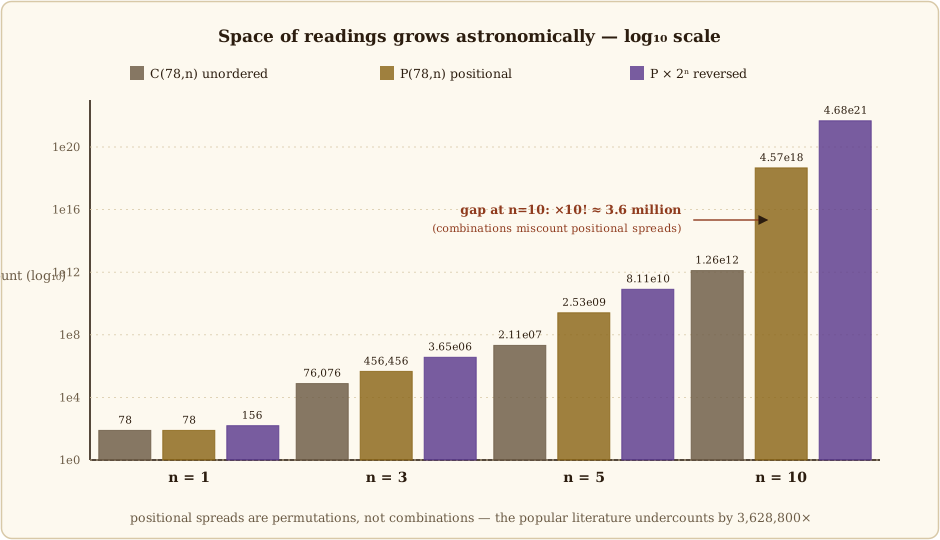
4.4.2 Counting is bounding. Positional spreads take permutations P(78,n), unordered displays combinations C(78,n), times 2ⁿ with reversals (Appendix A-4, full table; existing popularizations miscount positional spreads with combinations, off by 3,628,800×).
Proof 4.1 (P/C = k!, correcting the magnitude). P(n,k) = n!/(n−k)!, C(n,k) = n!/[k!(n−k)!]; dividing gives P/C = k!, independent of n. At k = 10: 10! = 3,628,800. Anyone who miscounts positional spreads with combinations underestimates the count by 3,628,800×. Some popular accounts print "3,600×"; division shows otherwise. QED.
The streak probabilities likewise follow from elementary derivations: the same card on two successive days = 78 × (1/78)² = 1/78; yesterday's card reappearing within seven days = 1 − (77/78)⁷ ≈ 0.0864; the expected number of distinct cards in thirty days = 78 × (1 − (77/78)³⁰) ≈ 25.0. The derivations are in the notes to the Appendix A-4 table.
Codicological note 4.4c (the auditability of the CSPRNG). The entropy source of the Fisher–Yates shuffle is crypto.getRandomValues (the Web Cryptography API); its security claim (unpredictability) is declared by browser vendors in their documentation and cannot be verified here. This book claims only that the uniformity of the sampling is auditable: a χ² test on the distribution of the seventy-eight cards (77 degrees of freedom; no significant p-value departure for n above 1000) checks it, and this site's engine implements it.
Proof 4.2 (streak formulas). Daily single draws are independent and identically distributed, P(X = c) = 1/78. (a) Same card two days: summing over faces, Σ_c P(X1 = c)P(X2 = c) = 78×(1/78)² = 1/78; three days gives 1/78² likewise. (b) Yesterday's card reappearing within seven days: 1 minus the all-seven-days-miss probability, 1−(77/78)⁷ ≈ 0.0864. (c) Expected distinct cards in thirty days: summing over faces, each face's at-least-once probability 1−(77/78)³⁰, expectation 78×(1−(77/78)³⁰) ≈ 25.04. QED.
Folk legend 4.4a (the Gypsy origin and the Death card's ill omen). Two persistent folk legends attach to tarot and repay careful disentanglement. The first holds that the cards came from the Gypsies — the Roma — brought into Europe from the East as they wandered; a nineteenth-century favourite, since the Roma's mysterious image and their close association with tarot divination made them a natural-seeming origin. The second holds that ill-omened cards such as the Death card (XIII Death) must not be touched, that touching them invites misfortune, and that the diviner should avoid or gloss over them in a reading.
On the first legend, the sociological resonance of the image should not obscure the chronological fact: the Roma appear in European records only in the fifteenth century, while tarot cards survive as physical Marseille decks from a period that predates those records. Historical research (this book, §4.2.1, cites Greer) has established that the tarot originated in the courts of northern Italy and has nothing to do with the Roma. The Gypsy-origin story is therefore a misattribution — one that confuses the subsequent association of divination practices with a shared origin, a logical error the transmission/form separation of §4.2.1 is designed to correct (criterion §5.2 takes form, not transmission route).
On the second legend, the Death card's original meaning is transformation and the end of an old phase; in the Golden Dawn system it corresponds to Scorpio, a sign explicitly signifying death and rebirth. The ill-omen taboo has no basis in the card-meaning system itself and is superstition introduced from outside it — folk emotional projection grafted onto the upright-reversed framework after the fact.
Both legends illuminate the book's core distinction: tarot's "astronomical coordinates" and its "folk narrative" are separate layers. The formal layer — 22 Majors mapped to planets and houses, 36 pips mapped to decans (§4.2.2) — consists of checkable, computable fact and serves as the substrate for corroboration. The folk-narrative layer — Gypsy origin, the taboo on ill-omened cards — is cultural association, neither verifiable nor falsifiable. The book's position is to accept the former as formal corroboration substrate and classify the latter as association, while acknowledging that the Gypsy legend's error lies not in its romantic appeal but precisely in the conflation of association with origin.
4.4.3 Positioning sentence. Mathematically, tarot is a discrete uniform sampler: the sampler produces no meaning (cf. §III.1, "distributions are countable"); meaning arises at interpolation — and whether interpolation is honest is exactly what Chapter V measures. This leads to Chapter V.