05 Corroboration
Authors: vaticinator.net & astrostarcheck.com
2026-08-31 · 05-corroboration.md
Chapter 5. Corroboration: Isomorphism Inventory, Criteria, Yoked Experiment
This chapter closes the monograph. The preceding chapters built the celestial model (02), three Eastern models (03), three Western models (04); this chapter presents the isomorphism inventory (§5.1), the corroboration criteria (§5.2), the exclusion of counterexamples (§5.3), and first-hand evidence from the yoked experiment (§5.4). The logic of the argument is this: isomorphism is formal fact, corroboration is criterial conclusion, experiment is incremental evidence — if any one is missing, the claim falls back to mere association.
5.1 Isomorphism Inventory (Formal-Fact Layer)
- Twelve–twelve: zodiacal twelve against Zi Wei twelve (§§3.3, 4.1), modulo-twelve labeling plus domain mapping, with seven directly comparable pairs (Life–1st, Wealth–2nd, Siblings–3rd, Property–4th, Children–5th, Spouse–7th, Career–10th) — different in wording, identical in skeleton.
- Twenty-eight triple tradition: Chinese xiu (headed by Jiao, unequal), Indian nakshatras (Ashvini at sidereal Aries zero, twenty-seven equal 13°20′ parts), Arabic manazil (zero tropical Aries, equal 12°51′ parts), sharing the 27.3-day step under a common-origin hypothesis (§§2.2, 4.3; Appendix A-2).
- Five–five: the five planets as the very names of the Five Phases; Jupiter's 11.86 years ≈ one twelve-year branch cycle; the chaochen–Taisui system, which shows the audit view in action (§3.1; Appendix A-1).
- Sixty-four–seventy-eight: sixty-four hexagrams fully binarizable, seventy-eight cards not (78 = 2×3×13, odd primes 3 and 13 in the factorization, so 78 is not a power of two). The argument needs one more step: if discretizations are locked by celestial periods (§2.2), then deck/hexagram counts should factor accordingly — 64 = 2⁶, pure binary, matching the recursion of yin-yang lines; 78 carries odd primes, matching the classification of inquiry (22 Majors on planet-house coordinates, 56 minors on elements and decans) rather than pure binary — so the asymmetry itself counts as evidence for the criteria (§3.2 vs §4.4).
- Three bivalent cases: Babylonian axiom sets, Fuxi visual isomorphism, tarot upright-reversed bivalence (the 2ⁿ column of Appendix A-4) — decreasing in formal strength, and together forming a spectrum.
All five can be verified independently, with no transmission hypothesis needed. They are the evidential base of the "necessary output" thesis.
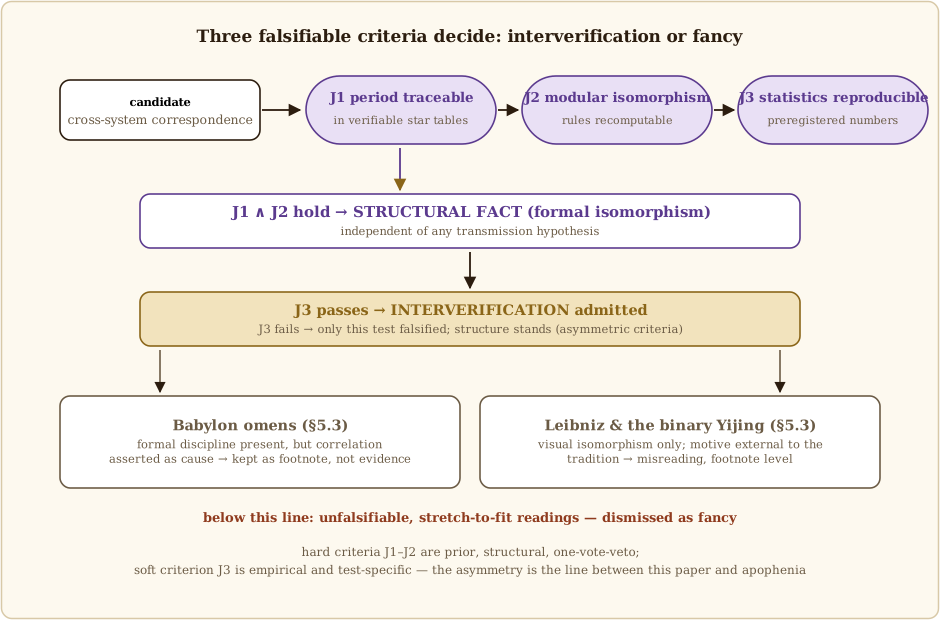
5.2 Corroboration Criteria (Failure of Any One Demotes to Formal Analogy)
- Documented common periodicity: the celestial periods involved must be checkable against ephemerides (for example, Jupiter's period against the Five-Phase assignment; if they prove unrelated, the criterion fails).
- Verifiable modular isomorphism: permutation, rotation, and table rules must be independently recomputable (Z₅, modulo twelve, sexagenary generation; any mismatch on recomputation fails it).
- Reproducible statistics: preregistered numbers that third parties can recompute (the Dresden table's reset-correction mechanism on record; this study's yoked experiment, preregistered — a null result fails it).
The criteria are asymmetric: the first two are hard — each enough on its own to reject a claim — while the third is soft (a null result falsifies only that test, not the formal isomorphism). Reason: the first two are structural and decidable a priori (periods checkable, modular rules recomputable, independent of the subject sample); the third is empirical and revisable post hoc (effect size depends on the sample, and insufficient power can wrongly read null) — so the first two are hard conditions, each enough on its own to reject a claim, and the third is merely supporting evidence. This asymmetry is the line between this book and "associative mysticism" — mere association accepts only positive results on the third criterion; this book requires the first two as necessary conditions.
Argument 5.2′ (deciding the twelve–twelve case). J1, common periodicity, is documented: Jupiter's 11.86 years locking the twelve-year round and the Moon's 27.3-day circuit locking twenty-eight stations, both checkable against ephemerides (Proof 2.4, Appendix A-1). J2, modular isomorphism, is verified: both sides use modulo-twelve labeling plus domain mapping, with seven directly comparable pairs (§3.3.3), and the rules can be recomputed independently. J3, reproducible statistics, is on record for both sides: independent invention is documented, and this study's yoked experiment is preregistered. Conclusion: the twelve–twelve correspondence meets all three criteria and counts as corroboration.
5.3 Exclusion: Demoting Babylon and Leibniz to Footnotes
Quoted text 5.3a (Enūma Anu Enlil, tablet 56; Akkadian transliteration, English translation attached). "UDU.IDIM ina ŠA₃ d30 GUB-iz ina MU BI DINGIR ina KUR GU₇ : 30 GAB MARki SU.GU₇ GAL₂-MEŠ" (TCL 06, 16; oracc/gkab) — "(If) a planet stands in the interior of the Moon: in that year, a god will devour in the land. (If) a planet stands in the right horn of the moon: there will be hunger in Amurru." (oracc)
Codicological note 5.3b. (i) The three lines instantiate the "if P then Q" conditional: planet in the Moon's interior → a god devours that year; planet on the Moon's right horn → famine in Amurru. Protasis astronomical, apodosis social, form fixed. (ii) This supports §5.3's claim that Babylonian omens satisfy the formal criteria, and its apodoses exemplify the correlation-as-causation object of critique: the text shows co-occurrence, never mechanism. (iii) The original is cuneiform; only transliteration and translation are given here, not an editorial reconstruction; tablet siglum per oracc/gkab P363689; a Boolean-algebraic formalization of the omen series (after De Zorzi’s reconstruction) is given by Schumann (2021).
The Babylonian bivalent omens and the Leibniz case do not enter the corroboration inventory; they are demoted to footnote evidence, each for one reason. The former satisfies the formal criteria, but its correlation-as-causation is precisely what this book criticizes (Rochberg's The Heavenly Writing, 2004, on the omen–astronomy symbiosis, agrees: formal discipline of omens does not equal causal knowledge) — listing it would confuse the argument. The latter meets only one of three criteria (visual isomorphism), with motives (the missionary–universal-language program; see Ryan 1996) that lie outside the object of study. Demotion is not deletion: both remain in the notes as the two ends of the misreading spectrum, setting a lower bound for corroboration — whatever falls below this line is called association, nothing more.
Folk legend 5.3c (the almanac's auspicious and inauspicious days). China's most widespread day-selection tradition — the almanac (shixianshu) — marks each day's "suitable" and "avoid" entries (suitable for marriage, avoid travel, and so on), and people choose auspicious days and avoid inauspicious ones accordingly. The tradition presents a clear stratification between astronomical substrate and cultural accretion that the book's criteria are well positioned to disentangle.
The astronomical basis is real and non-trivial. The almanac's "twelve day-officers of the jianchu cycle" (jian, chu, man, ping, ding, zhi, po, wei, cheng, shou, kai, bi) are a mod-12 projection of the month-branch rotation: the first month of the year is jian-yin, counted from "jian," advancing one officer each day — a structure isomorphic with the "month-branch plus hour" mod-12 rotation of §2.2. Separately, the almanac's "auspicious days of the yellow path" attach to the solar zodiacal division, following the day-order of the twelve signs. Both systems are therefore reducible to modular computation and checkable against the ganzhi rotation of Appendix A-2.
Folk taboos, however, reach well beyond that computationally traceable substrate. Choosing a wedding day may also require avoiding the "Three Niang's balefulness" or "Lord Yang's prohibitions" — designations that carry no astronomical referent and belong wholly to mythology. More broadly, the treatment of inauspicious days as having "nothing suitable" is inflated without formal limit, so that the almanac risks becoming a machine for manufacturing anxiety rather than a structured calendar.
The distinction is substrate versus accretion: whatever can be reduced to modular computation is credited to the formal layer of corroboration; whatever cannot is classified as association. The book applies this criterion consistently to the almanac. One observation, however, is worth foregrounding in its own right: the very "suitable/avoid" architecture of the almanac — however mixed its execution — represents a folk form of statistical projection, or frequency induction, and its existence therefore confirms the statistical character of fortune-telling as defined in §2.3.
Argument 5.1′ (deciding the Leibniz case item by item). J1, generative rules, fails: positional binary counting versus milfoil hexagram derivation have no shared mechanism history. J2, operational closure, fails: there is no instance of computing hexagrams in binary with faithful back-translation. J3, direction of interpretation, fails: it serves the missionary–universal-language program, outside the Yi agenda itself. All three fail, so the verdict is misreading; the fact that Leibniz turned the episode to productive use (advancing the universal-language program) changes nothing in the verdict — it only explains the historical influence.
5.4 The Yoked Experiment: Does a Shared Substrate Predict Cross-System Agreement
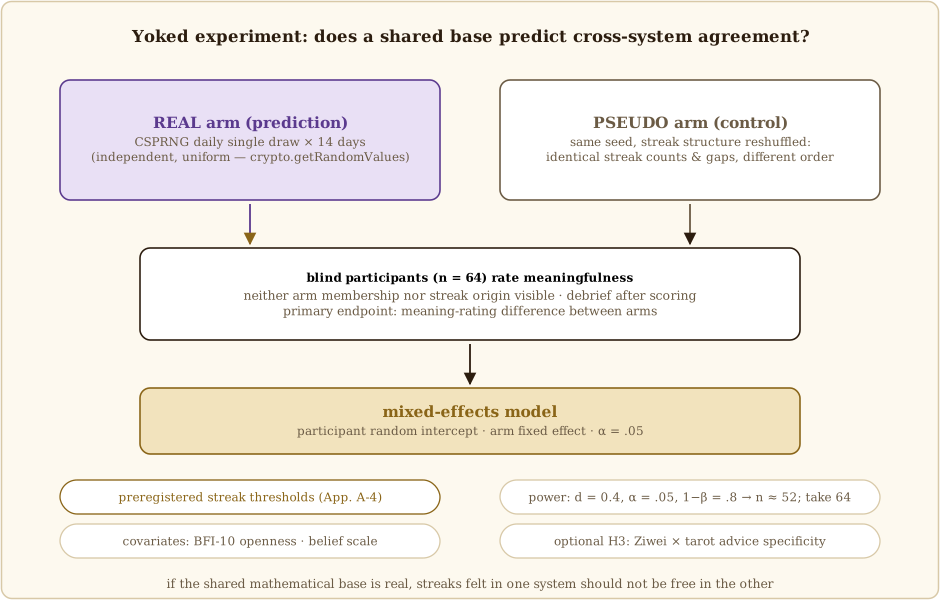
The protocol follows the established design: true-random streaks (one draw a day for fourteen days) as the prediction arm, structurally matched pseudo-streaks as the control arm, and blind meaning ratings; n = 64, α = .05; covariates are BFI-10 openness (Rammstedt & John 2007) and a brief paranormal-belief scale (Tobacyk 2004); the design also includes a CSPRNG audit, OSF preregistration, and a post-experiment debrief. On randomization: the pseudo arm reuses the true arm's streak statistics (counts and intervals) with the order permuted, so the two arms share identical statistical properties and differ only in order, which is what makes the blind effective. Subjects never learn their arm and are debriefed after scoring. The statistical model is mixed-effects (random subject intercepts, condition fixed; estimation per Bates et al. 2015), with the primary effect defined as the gap in meaning ratings between true and pseudo streaks. An optional hypothesis H3 bridges the corroboration framework: if a shared mathematical substrate is real, then the same subject's Zi Wei career-house reading and tarot career-spread reading should show a significant positive correlation in "advice specificity" (H3 does not affect the power of the primary test). Following Dresden practice, all streak-detection thresholds of this experiment (same-card pairs, same-family triples, seven-day revisits) are preregistered in the footnotes to the Appendix A-4 probability table, with no changes allowed afterward.
Derivation 5.4′ (how the sample size n = 64 was chosen). A paired design whose primary effect is the gap in meaning ratings between true and pseudo streaks. Assume a medium effect (d = 0.4), α = .05 two-sided, and power .8. The normal approximation gives n ≈ ((1.96+0.84)/0.4)² ≈ 49; correcting for the t distribution gives about 52. We take 64, allowing about 20% for dropout. H3 is optional and does not affect the power of the primary test. A null result on the primary outcome fails only this one test of the third criterion and leaves the formal isomorphism untouched (see the asymmetry of the criteria, §5.2).