06 Conclusion
Authors: vaticinator.net & astrostarcheck.com
2026-08-31 · 06-conclusion.md
Chapter 6. Conclusion: One Sky, Different Paths, Same Destination
6.1 Answering the Introduction
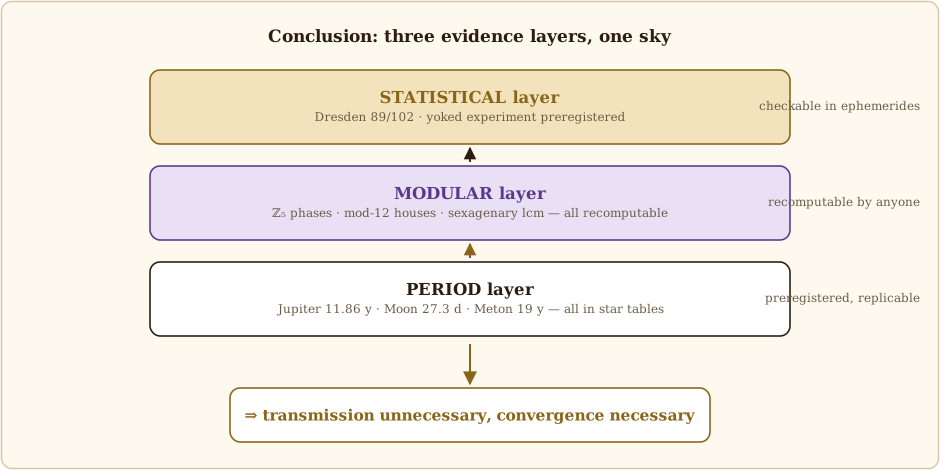
The introduction asked: why did civilizations thousands of miles apart divine fate with isomorphic mathematics — the result of transmission, or a necessary output? This book answers in favor of the latter. On the periodic side, Jupiter's 11.86 years locks the twelve-year cycle, the Moon's 27.3-day circuit locks twenty-eight stations, and stem-branch arithmetic locks sixty by least common multiple — step sizes locked by celestial bodies, packaging left to civilizations. On the modular side, Z₅ permutations, modulo-twelve rotations, and sexagenary generation rules can be recomputed independently, with identical results. On the statistical side, the Dresden table's reset-correction mechanism is on record, and this study's yoked experiment is preregistered. Transmission may well have occurred, but it is neither necessary nor sufficient for the conclusion: even setting aside every transmission hypothesis, the isomorphism stands. That is all "necessary output" means.
6.2 Historiographic Position: This Book in the Neugebauer–Needham–Rochberg–Cullen Line
Paraphrase 6.2a (the argument of Needham's Science and Civilisation in China, vol. 2; a paraphrase, not a quotation). Needham treats the Chinese calendrical tradition as an independent lineage beside Babylon and Greece: likewise grounded in observation, likewise using arithmetic or geometric models as instruments; but China's distinctive feature is its unbroken record of measurement, and an annalistic form in which observation and computation stand side by side. (Paraphrased from the English text.)
Codicological note 6.2b. (i) Needham's "observation and computation side by side" is the modern scholarly origin of this book's notion of "model–observation audit" (mutually corroborating §2.1.3 and §3.1.2). (ii) The preceding item is an argumentative paraphrase, not a verbatim quotation; this is stated expressly to prevent its being mistaken for a citation. (iii) With this note, the genealogical placement of §6.2 (Needham stopping at independent invention) has textual support, not merely second-hand survey.
Neugebauer proved Babylonian planetary tables are piecewise-linear algorithms; Needham proved China's calendrical tradition an independent interpolation lineage; Rochberg proved omen literature formally disciplined yet causally empty; Cullen proved the Wuxingzhan an interlocked text of planetary data and Five-Phase frame. All four analyzed the computational traditions of single civilizations; none took the next step: using falsifiable criteria to decide whether cross-civilizational isomorphism counts as corroboration or mere association. This book takes that step; its contribution is not new sources but criteria — if any one of the three fails, the claim is demoted, a self-demotion mechanism none of its predecessors had.
Argument 6.1 (the logical form of the increment). P1: all four predecessors satisfy single-civilization formal analysis, and none satisfies cross-civilizational falsifiable criteria (Neugebauer set no cross-civilizational test; Needham stopped at independent invention; Rochberg at single-tradition formal discipline; Cullen at single-text interlock). P2: this book adds a layer of criteria — if any one of three fails, the claim is demoted. Conclusion: the increment lies not in new sources but in the adjudication mechanism. It is established by deduction, independent of future archaeology.
6.3 An Honest Place for Fortune-Telling, with Scope Limits
This book does not defend any supernatural claims of fortune-telling. It delimits an honest place for it: statistical analysis of a celestial mathematical model's long observational record, projected as life-trajectory narrative. Systems that admit the narrative-interpolation step and accept audit (Dresden kept correction records; this study preregisters) can be treated as empirical claims open to discussion. Systems that deny interpolation, immunized by stretchable interpretation, count as association — where most current tarot reading is found, and what Chapter V measures, not what it tries to rescue. Scope limit: this book asserts no psychological causal mechanism (why particular narratives persuade is a question for psychology), only mathematical isomorphism and reproducible statistics; the author does not endorse extrapolations beyond this limit.
6.3b Two Folk Legends in Closing: The Fortune-Teller's "Both-Ways Blocking" and the Oracle Slip
Legend one (the fortune-teller's both-ways blocking). A folk saying mocks fortune-telling: "Ask about advancement, and none is denied; ask about wealth, and none fails to prosper; ask about calamity, and none fails to be averted; ask about marriage, and no match is unmatched" — the so-called both-ways blocking. Whatever the querent asks, the reading goes either way, and afterwards is always made self-consistent. The saying actually touches the core: a fortune-telling reading is "low-entropy input, high-entropy output" narrative interpolation (§2.3), its narrative space far larger than its data. But that same feature is the clearest possible demonstration of unfalsifiability: if a reading can go either way, then every result counts as "efficacious," which is precisely the stretchable interpretation that §5.3 criticizes. Both-ways blocking is the most direct folk confirmation of this book's criteria (§5.2) — a monument to taking only the positive results of statistical projection and discarding the negative.
Legend two (drawing oracle slips and their poems). The oracle slip common in Taiwan and South China: at a temple one draws a numbered slip, matched to a poem (four seven-character lines), and the poem's sense decides good or ill fortune. Drawing a slip is sampling, structurally identical to the discrete sampler of §4.4; the sixty (or hundred) slips form a discretization scheme. But the poems are mostly vague verse ("the clouds part, the moon comes out, all is now clear," and the like), fitting anything at all. Oracle-slip drawing contains both elements that run through this book: a formal layer that is auditable, and a narrative layer that is not. The probability structure can be verified; the poem's interpretation cannot.
Overall assessment. All seven folk legends (the zodiac animals, the zodiac year, Fuxi and King Wen, the almanac, the Gypsies, both-ways blocking, oracle slips) share the same structure: a mathematical layer and a narrative layer coexisting in one system. This book's criteria aim to cut the two apart. What wants to set the narrative above the mathematics is demoted to association. The cut is not a judgment against folk wisdom as such — these traditions preserved genuine intuitions about astronomical structure — but against the habit of substituting narrative for structure and calling the result causal knowledge.
6.4 Unfinished and Open
Three items remain: first, the Zi Wei–tarot advice-specificity contrast (H3) needs an independent sample; second, the East–West element contrast experiment (Fire–Water versus Wood–Earth conflict ratings) needs a cross-cultural pool; third, formalizing oracle-bone verification inscriptions as "ancient audit" (comparing the charge–crack–verify three-part form with the structure of preregistration) deserves a paper of its own. All three are decidable and falsifiable under this book's criteria; that work is left for the future.