Appendix
Authors: vaticinator.net & astrostarcheck.com
2026-08-31 · A-appendix.md
Appendix: Recomputable Tables
Every table is independently recomputable; methods in table notes. Conventions in each header row.
Table A-1 Five Planets: Periods and Chinese Names
| Planet | Old Chinese name | Phase | Sidereal period | Synodic period |
|---|---|---|---|---|
| Mercury | Chenxing | Water | 88 days | 116 days |
| Venus | Taibai | Metal | 225 days | 584 days |
| Mars | Yinghuo | Fire | 687 days | 780 days |
| Jupiter | Suixing | Wood | 11.86 years | 399 days |
| Saturn | Zhenxing | Earth | 29.46 years | 378 days |
Note: periods rounded from NASA planetary fact sheets. Sidereal periods lock chronology cycles (Jupiter's 11.86 years ≈ one twelve-year branch cycle, §3.1); synodic periods pace omen windows (stations, retrogrades, and morning/evening visibilities — the Wuxingzhan omens attach mostly to heliacal events for exactly this reason). The Mawangdui Wuxingzhan (ca. 170 BCE) casts from these five stations (Cullen).
Table A-2 Bagua Three-Bit Binary (Fuxi Order, yang = 1, Top-Down)
| Name | Top | Middle | Bottom | Binary value |
|---|---|---|---|---|
| Qian | yang | yang | yang | 7 |
| Dui | yang | yang | yin | 6 |
| Li | yang | yin | yang | 5 |
| Zhen | yang | yin | yin | 4 |
| Xun | yin | yang | yang | 3 |
| Kan | yin | yang | yin | 2 |
| Gen | yin | yin | yang | 1 |
| Kun | yin | yin | yin | 0 |
Note: the Bouvet–Leibniz reading; on the direction dispute see Ryan 1996 — adopted here while noting that the dispute stands, with no substantive claim made.
Table A-3 Major Arcana Correspondences (Book T, 1888)
| Card | Correspondence | Card | Correspondence |
|---|---|---|---|
| 0 Fool | Aether | XI Justice | Libra |
| I Magician | Mercury | XII Hanged Man | Water |
| II High Priestess | Moon | XIII Death | Scorpio |
| III Empress | Venus | XIV Temperance | Sagittarius |
| IV Emperor | Aries | XV Devil | Capricorn |
| V Hierophant | Taurus | XVI Tower | Mars |
| VI Lovers | Gemini | XVII Star | Aquarius |
| VII Chariot | Cancer | XVIII Moon | Pisces |
| VIII Strength | Leo | XIX Sun | Sun |
| IX Hermit | Virgo | XX Judgement | Fire |
| X Wheel | Jupiter | XXI World | Saturn |
Note: per Mathers' Book T (1888, sacred-texts facsimile); formation history in Dummett 1980, Dummett & McLeod 2004. The Fool takes Aether (Spirit of Aether); the popular alternative assigning Air is discussed in §4.2. Sun, Moon, Star are celestial bodies themselves (§4.2).
Table A-3b Egyptian Thirty-Six Decans: Summary
| Item | Content |
|---|---|
| Count | Thirty-six star groups, ten degrees each |
| Timekeeping | Thirty-six night hours; thirty-six ten-day weeks (plus five days) |
| Visual evidence | Thirty-six figures on the outer ring of the Dendera disc, twelve houses inside |
| Mathematical meaning | Thirty-six equals three times twelve: a recursive refinement of twelve |
Note: see §4.1. Decans served both calendrical and astronomical timekeeping, showing discretization as shared calendrical mathematics.
Table A-3c Persian Planets Paired with Constellations (Bundahishn, ch. 5)
| Planet | Persian name | Paired constellation |
|---|---|---|
| Mercury | Tīr | Tishtar |
| Mars | Vāhrām | Haptok-ring |
| Jupiter | Aūharmazd | Vanand |
| Venus | Anāhīd | Satavês |
| Saturn | Kēvân | Gôkīhar |
Note: West translation. The sevenfold pairing runs parallel to, but separate from, India's navagraha and China's seven luminaries; see §4.2.
Table A-4a Tarot Combinations (Seventy-Eight Cards: 22 Majors, Four Suits of 14, Reversals Independent)
| n | Unordered C(78,n) | Positional P(78,n) | With reversals P×2ⁿ |
|---|---|---|---|
| 1 | 78 | 78 | 156 |
| 3 | 76,076 | 456,456 | 3,651,648 |
| 5 | 21,111,090 | 2,533,330,800 | 81,066,585,600 |
| 10 | 1,258,315,963,905 | 4,566,176,969,818,464,000 | 4,675,765,217,094,107,136,000 |
Note: positional spreads require permutations; existing popularizations use combinations, erring by 3,628,800× (10!, proved in §4.4).
Table A-4b Named-Event Probabilities
| Event | Probability |
|---|---|
| ≥1 Major in 3 | 0.6356 |
| ≥1 Major in 5 | 0.8191 |
| ≥1 Major in 10 | 0.9717 |
| 3 same-element | 0.039382 |
| 5 same-element | 0.001627 |
| Tower and Star in a 3-card spread | 0.000999 |
| Tower and Star in a 5-card spread | 0.003330 |
| Tower and Star in a 10-card spread | 0.014985 |
| ≥1 of 4 named cards in 5 | 0.2370 |
Table A-4c Daily Single-Draw Streak Probabilities (Independent Days)
| Event | Probability |
|---|---|
| Same card 2 days | 0.0128 (≈1:78) |
| Same card 3 days | 0.000164 (≈1:6,084) |
| Same element family 2 days | 0.2084 |
| Same element family 3 days | 0.0456 |
| Yesterday's card reappears within 7 days | 0.0864 |
| Expected distinct cards in 30 days | 25.0 |
Note (A-4b, A-4c): streak derivations: same-card pair = 78×(1/78)²; seven-day revisit = 1−(77/78)⁷; thirty-day distinct expectation = 78×(1−(77/78)³⁰). Streak thresholds (same-card pairs, same-family triples, seven-day revisits) are this study's preregistered thresholds, with no changes allowed afterward.
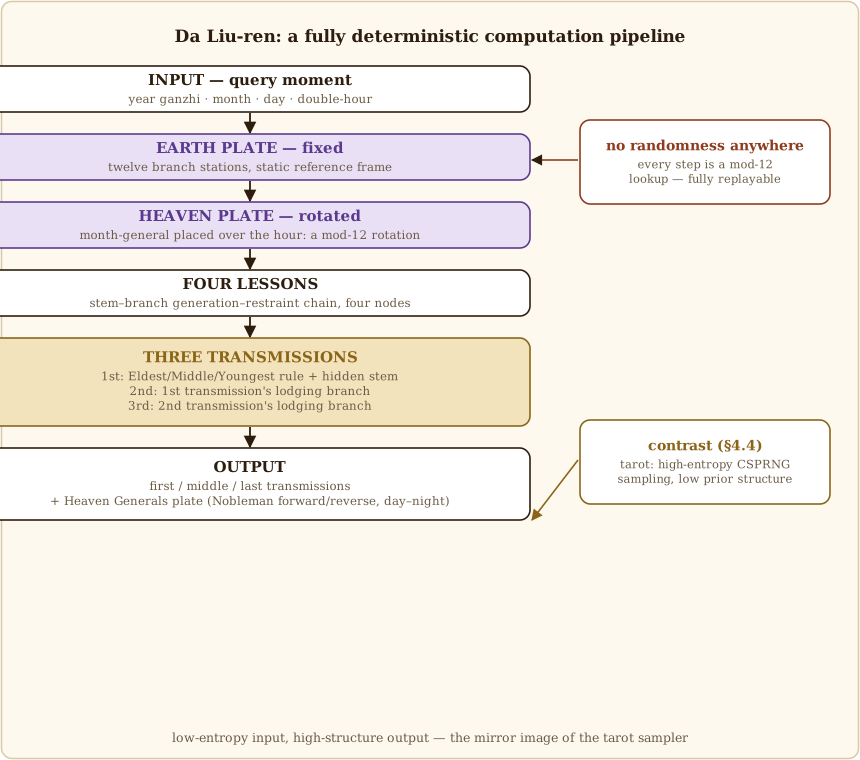
Figure A-1 Liuren Information Flow
Note: every step is modulo-12 table lookup, with no randomness source; compare tarot CSPRNG sampling (§4.4).
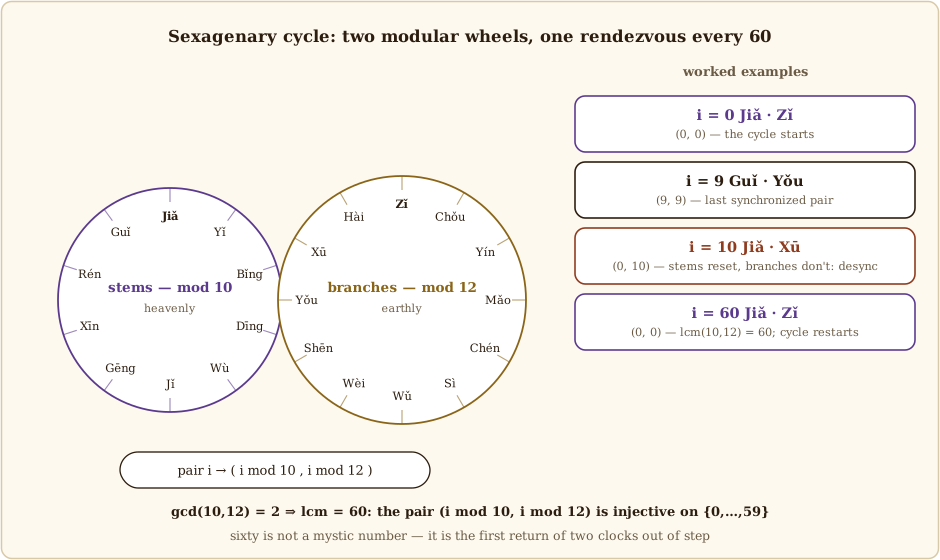
Figure A-2 Sexagenary Generation Rule
Ten stems and twelve branches are both modular sequences; least common multiple lcm(10,12) = 60. Pairing is the first sixty joint solutions: i = 0 Jiazi (stem 0, branch 0), i = 1 Yichou, … i = 9 Guiyou (stem 9, branch 9), i = 10 Jiaxu (stem 0, branch 10) — the mechanism by which stem-branch desynchronization exhausts at exactly sixty, restarting at sixty-one. That is all "the sixty-cycle's mathematical necessity" means, verifiable in one line of code.